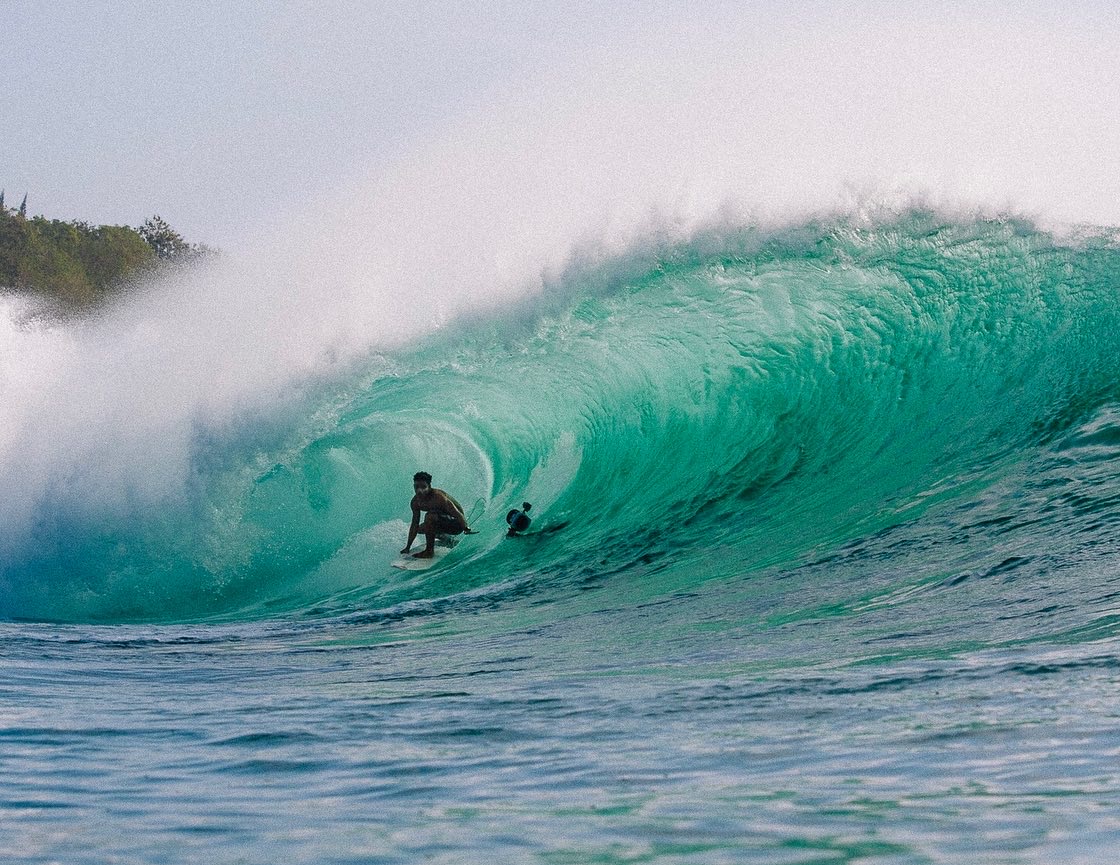
Padang-Padang is one of the best surf breaks in Uluwatu, if not the whole of Bali. You might have come across Padang-Padang in Julia Roberts’ Eat, Pray, Love movie, or you’ve seen the clips when swell hits Padang-Padang Beach. However, is Padang-Padang Beach the best place in Bali to surf for a beginner?
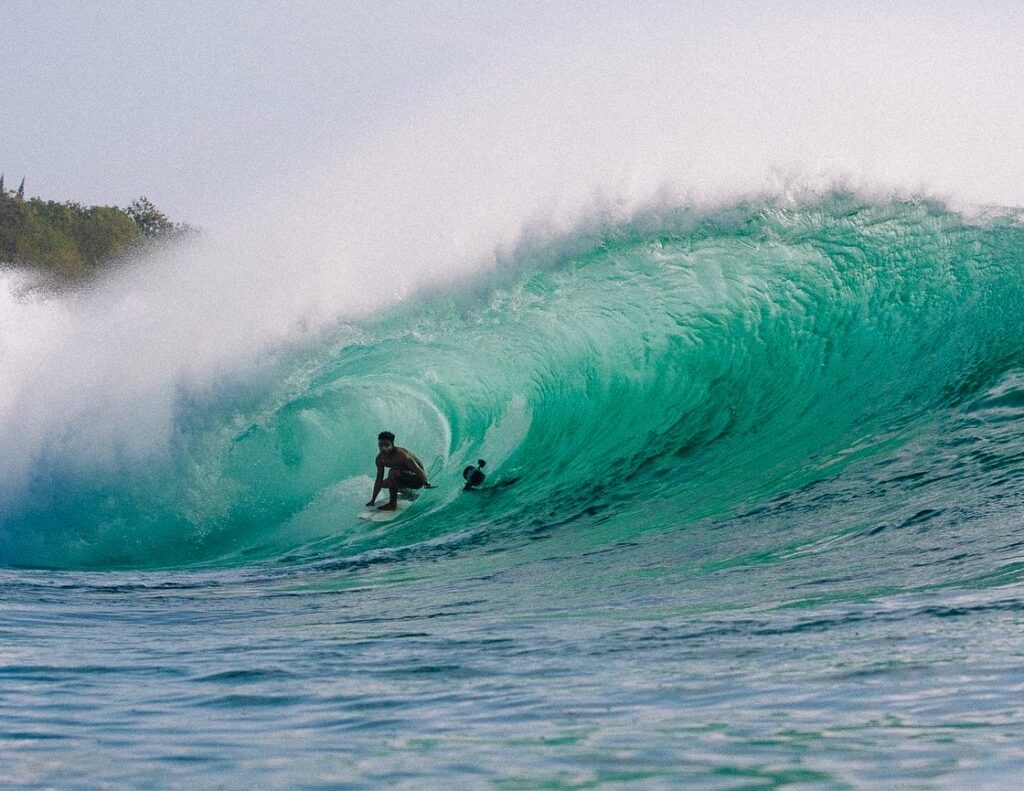
Padang-Padang Beach itself has two different breaks:
- The “Bali Pipeline” (Padang Padang Left): This is the world-famous, heavy, barreling reef break. It’s for experts only. If you fall here, the reef is shallow and sharp.
- Padang Padang Right (Baby Padang): This is a perfect for beginners and intermediates. A rolling right reef break that peels into a deep channel, paired with a softer left.
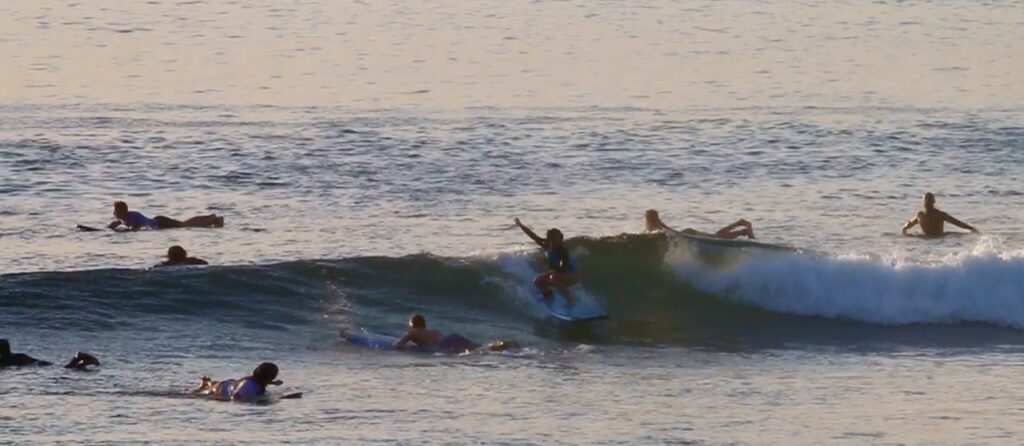
Having taught over hundreds of students with different levels, the honest truth about surfing at Baby Padang is that not all conditions are best for beginner students.
For a total beginner, we aren’t looking for “green” (unbroken) waves yet. We are looking for broken crumbly white wash. Ideally, we look for white wash with a bit of “punch.” That forward momentum acts to stabilise the board. When the wave has enough energy to push you consistently, the board stays flat and steady, giving you a much larger “window” of time to find your feet and stick the pop-up landing.
The “Slow” White Wash: If the swell is too small or the tide is too high, the white wash becomes “fat” and weak. Without enough push, the board feels wobbly and sinks when you try to stand up. It’s actually much harder to find your balance on a slow wave.
In this post, we will breakdown exactly what conditions are best for beginners and advanced beginners when surfing at Baby Padang.
Overview of Padang-Padang Beach
What are the great conditions at Baby Padang Beach for beginners?
Please tap on each subheader for more information.
This refers to the angle that the waves are coming from.
For Padang-Padang: SW (Southwest) is the “magic” angle. It hits the reef perfectly to wrap into the bay
This refers to the time (in seconds) between wave crests.
Higher is more powerful. For Baby Padang-Padang, 12s-14s are great for beginners and intermediate. The waves are organised, the sets are predictable, and there is enough push to carry a high-volume board for a long ride.
Any swell with a period over 14 seconds means the ocean is moving a lot of water. For beginners, this can mean stronger currents in the channel and significantly bigger sets that can feel intimidating.
This refers to The depth of the water over the reef (0.0m to 2.5m).
Mid-Tide (0.8m – 1.6m) is great for those looking to surf in Baby Padang as it provides a cushion between the waves and the reef floor. If the swell is small, you would want to aim for 0.8m – 1.0m. This is because if the swell is small, higher tide could mean that the wave might not even break.
The Low Tide Warning (Below 0.8m): When the tide is too low, the reef floor becomes exposed. Not only does this make falling more dangerous, but it also changes the wave’s shape—it often becomes “shorter” or faster, meaning you have less time to pop up before the wave runs out of water.
The High Tide Struggle (Above 1.8m): While more water usually means more safety, a high tide pushes more volume into the bay, which significantly strengthens the currents. You’ll find yourself constantly paddling just to stay in the lineup, which can quickly exhaust a beginner.
We usually only head to Baby Padang when the swell is no more than head-high. If the waves do get bigger than this, the current becomes too strong for beginners.
Offshore Wind: Wind blowing from the land toward the ocean.
During Bali’s Dry Season (April to October), we get the Southeast (SE) Trade Winds. At Padang Padang, these are offshore, meaning they blow from the land out to sea. This makes the faces smooth, clean, and perfectly shaped for those looking to catch their first green waves.
While intermediate and pro surfers will be looking for glassy”or offshore winds, as a beginner in the white wash, the wind factor is less important. This is because Padang Padang is a reliable reef break, it produces consistent white wash in almost all wind conditions.
Dry Season (April to October) tends to have more favourable winds as compared to wet season. For a comprehensive breakdown of when and where to surf in Bukit Peninsula, see our guide here (Uluwatu Surf 101 for Beginners).
In surfing, a current is a body of water moving in a specific direction.
At Padang-Padang Beach, the current carries you right to the lineup when you paddle. However, in bigger waves, beginner students might not even realise they are being pulled into the open ocean by the current until they look back and realise they are away from everyone else in the lineup.
For someone who has never surfed before, they might get tired quicker as stronger current means that they would need to constantly paddle against the drift to stay in the take-off zone.
To avoid getting tired out by strong current, choose days with lower swell period and smaller heights on [what tide], this ensures that the waves are calmer so beginner surfers can actually relax between sets.
Using the Channel as a Pit Stop: At Padang-Padang Beach, there is a deep-water channel on the right side of the line-up. If you are not waiting for your turn in the line-up, or if there is a big set coming, go to the channel for safety.
The biggest mistake beginners make is paddling straight back up the “face” of the wave after a ride.
After you finish a right-hand wave, always paddle toward the deep-water channel first. This keeps the lineup clear for the next person. If you paddle straight back through the middle, other surfers would have to dodge you and even ruin their ride.
What to do as a beginner if there is a big set coming?
If you see a set of larger waves approaching the horizon, paddle towards the right into the deep-water channel.
Because the water is deep, the waves won’t break on your head in the channel. You can sit safely in the channel, watch the big sets pass, and wait for the “lull” before heading back to the takeoff spot.
mANAGING tHE cROWD IN THE lINEup As A Beginner
During the dry season (June–August), the lineup can get incredibly busy.
If you are tired, adjusting your leash, or simply waiting for your turn in the lineup, stay in the channel.
Sitting right on the peak when you aren’t ready to catch a wave adds to the and confusion. This can be incredibly dangerous especially when there’s a sudden set wave. By waiting in the channel, you stay safe while keeping a clear eye on when it’s your turn to catch a wave.
What level of surfer do I need to be to surf at Padang-Padang Beach?
For more advanced surfers and longboarder, staying near the peak allows you to catch a right powerful green waves or a longer left that can
1. Beginner to Intermediate: The “Baby Padang” Right
If you are still practicing your pop-up, learning to trim along a wave, or riding a longboard, the right-hand break is for you.
- The Level: First timers, advanced beginners to Intermediate
- The Wave: A soft, rolling reef break that peels toward a deep-water channel. It is forgiving and provides a long ride that is perfect for building confidence on a reef.
- The Requirement: You should be comfortable in the water, have basic swimming skills and have a basic understanding of surf etiquette and falling technique, as this area can get very crowded with surf schools.
2. Advanced to Professional: Padang-Padang Left
If you see the world’s best surfers heading toward the far left of the bay, they are chasing the famous Padang Padang Left.
- The Level: Advanced to Professional only.
- The Wave: A fast, shallow, and heavy tube or barrel. It breaks over a sharp, shallow reef and is one of the most dangerous waves in Bali.
- The Requirement: You must be an expert at steep take-offs and comfortable surfing in hollow sections.
3. Advice for More Advanced Surfers & Longboarders
For intermediates and longboarders, staying near the peak (the point where the wave first breaks) allows you to catch the wave at its most vertical point. Here, you can drop into a powerful green wave that offers enough “push” for carving turns or walking to the nose of a longboard.
The Longer Left: While most people focus on the right, more advanced beginner/intermediate surfers at the peak can also take the longer left. It can offer a long, soft shoulder that is perfect for stylish cutbacks and a longer ride.
WHEN Is the Best Time TO SURF BABY PADANG
Baby Padang is a well known spot for surf schools, it can get really busy during the dry season. We usually head out early in the morning (6am/7am) to avoid mid-day crowd!
Another plus of heading out early is that with the first light hitting the cliffs, our students score incredible in-water shots against the sunrise and video footage with that iconic, glistening turquoise water.
The experience changes slightly depending on the time of year:
- Dry Season (April – Oct): This is when the SE Trades are blowing offshore. The waves are flat, and clean. It’s the most consistent time to surf, but also the most crowded.
- Wet Season (Nov – March): When the wind switches to onshore, the water at Padang Padang gets much quieter. Most surfers head to Nusa Dua or the East Coast looking for glassy conditions. If you’re lucky, you can score some surprisingly quiet, offshore sessions at Padang during the wet season. It’s a gamble, but when it pays off, you have the place almost to yourself!
During the Wet Season, when the waves in Uluwatu are less than ideal due to the wind, we run our East Coast surf trips. We head to spots like Nusa Dua where the conditions stay clean and manageable for beginners, ensuring you get the best possible waves regardless of the month.
It is important to remember that every wet season follows its own rules. We’ve noticed that conditions can vary significantly from year to year; for example, this year has actually gifted us far more offshore mornings at Baby Padang compared to last year. Because the weather can be so unpredictable, we always suggest reaching out to us before you officially book your tickets. If you are concerned about the forecast, just send us a message so we can give you a real-time update on the local conditions. We want to make sure you are heading to the right coast for the best waves, whether that is here in the Bukit or on one of our East Coast adventures.
Food/Drinks at Padang-Padang Beach
Down at the beach, the local warungs right on the sand at Padang-Padang Beach have everything you need to recharge. You’ll find a variety of drinks, chilled bottled water, fresh coconuts and Bintang beer.
If you’re hungry for a proper meal, they offer classic Indonesian favorites like Nasi Goreng (fried rice), Mie Goreng (fried noodles) or western food.
Do remember to bring enough Indonesian Rupiah in cash as you’ll need it for things such as beach entrance fee, parking, board rentals, any souvenirs and snacks you pick up from the local warungs down at the beach and any photo/video footage from the photography stand.
During the weekends, there will usually be a beach bar set up just in time for sunset, with occasional live music. It is truly a once-in-a-lifetime experience to sit on the sand with a drink in hand, watching the sky turn pink over one of Bali’s most famous surf breaks.
Final Tip: When in Doubt, Don’t Go Out
The ocean speaks a language of its own. While Padang Padang is famous for its beginner-friendly right-hand wave, the ocean can change rapidly.
How to spot a “Code Red” day from the cliff:
- Watch for 15 minutes: Don’t just look for 30 seconds. Wait for the big sets to pulse through.
- Look at the bubbles: Watch the foam on the water. Is it racing toward the rocks or out to sea? That’s your current.
- Check the Lineup: Are there only pros in the water? If the local instructors are staying on the sand, you should too.
On bigger days, Poggy Bali Surf School will either postpone lessons or move to a more protected spot such as Jimbaran Beach or Honeymoon Beach that is safer for beginners and intermediates.
The Spring Tide Factor (New Moon)
During a New Moon (and Full Moon), the sun and moon align, creating Spring Tides. .
During these periods, the ocean moves a huge volume of water in a short window (6 hours). This causes the current at Padang Padang to become much stronger than usual. You will likely feel the ocean “pushing” against you more than on a normal day, which means you need to be prepared with enough physical energy to paddle against a current.
During new moon, the tide and water level shifts rapidly. Therefore, you would need to stay aware during these sessions to ensure you do not injure yourself due to low tide. Even if you head out at mid-tide, the depth over the reef floor can change before you even realise, leaving the reef floor exposed and increasing the risk of injury.
Surprising Cleanup Set
A cleanup set is a wave (or series of waves) that is significantly larger than the average set and breaks much further out than where everyone is sitting. If you are sitting where the normal waves break, you can be caught in the impact zone where a cleanup set will land directly on your head. If you are thinking of heading out on a bigger day, you would need to know how to navigate a cleanup set at Padang-Padang Beach.
For a beginner with a large, high-volume and heavy foamboard, this can be incredibly intimidating and dangerous experience. If you are taking a surf lesson, do pay attention during the safety briefing as the instructors will teach you how to handle a bigger set wave. Do stay close to your instructor throughout the lesson as they will know when the set waves approach and will usually guide you to the safe channel before a set wave is approaching.
Eddies and Cross-Currents
When massive swells hit the limestone cliffs of Uluwatu at an angle, the energy doesn’t just stop, it bounces back. This creates Eddies (circular whirlpool-like currents) and Cross-currents.
Instead of being pushed toward the beach, you might find yourself being pulled sideways toward the jagged rocks at the base of the cliffs. Beginners often panic here because they feel they are paddling hard but moving in the wrong direction.
If you feel that sideways pull, look to your instructor immediately; they will guide you on the correct angle to paddle to avoid getting pulled away from the lineup.
What to do after surfing at Padang-Padang Beach?
Our recommendations for after sunrise surf:
- For those craving a polished, modern brunch experience with incredible atmosphere, we love heading to Ours Restaurant.
- If you are instead looking for an authentic Indonesian meal at an incredible price, we always recommend a trip to our favorite hidden local spot, Warung Bu Johnny.
Our recommendations after sunset surf:
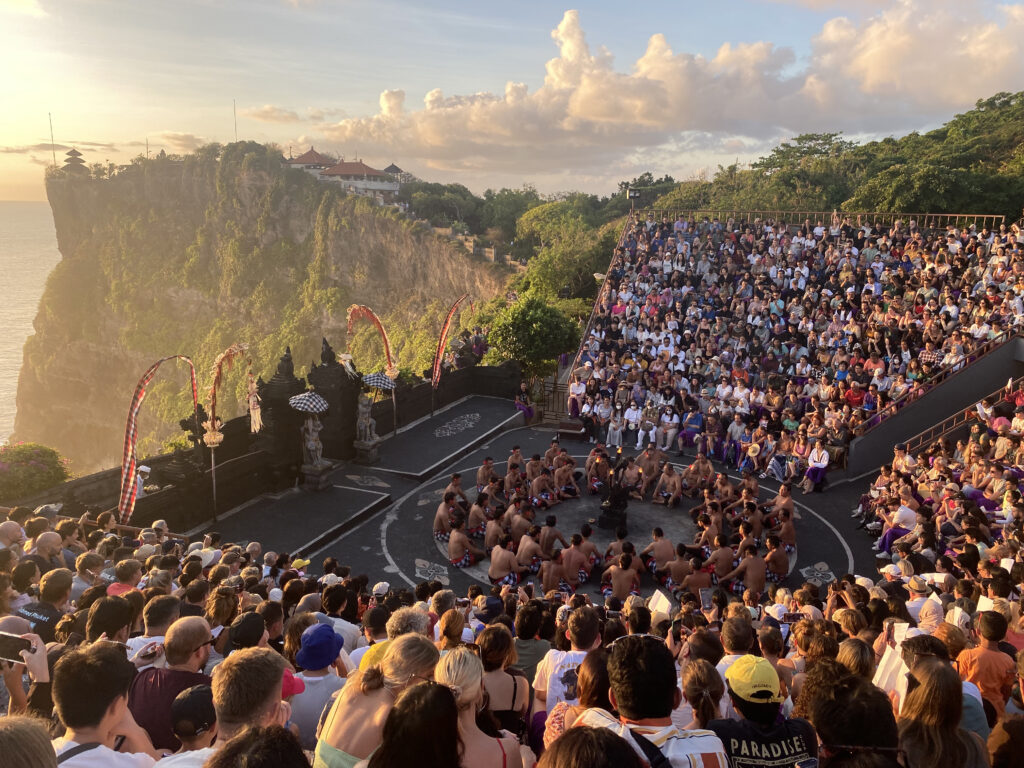
- Just a short ten-minute drive by car or bike from Padang Padang Beach is the majestic Uluwatu Temple, perched right on the edge of the towering limestone cliffs. This is the home of the legendary Kecak Fire Dance, an immersive cultural experience that takes place in an open-air amphitheater as the sky turns to dusk.
- For those whose appetite is as big as the swell, heading to Jimbaran or Kedonganan for a seafood dinner on the beach is the best place to be. You can enjoy the freshest catch of the day while enjoying the sea breeze.
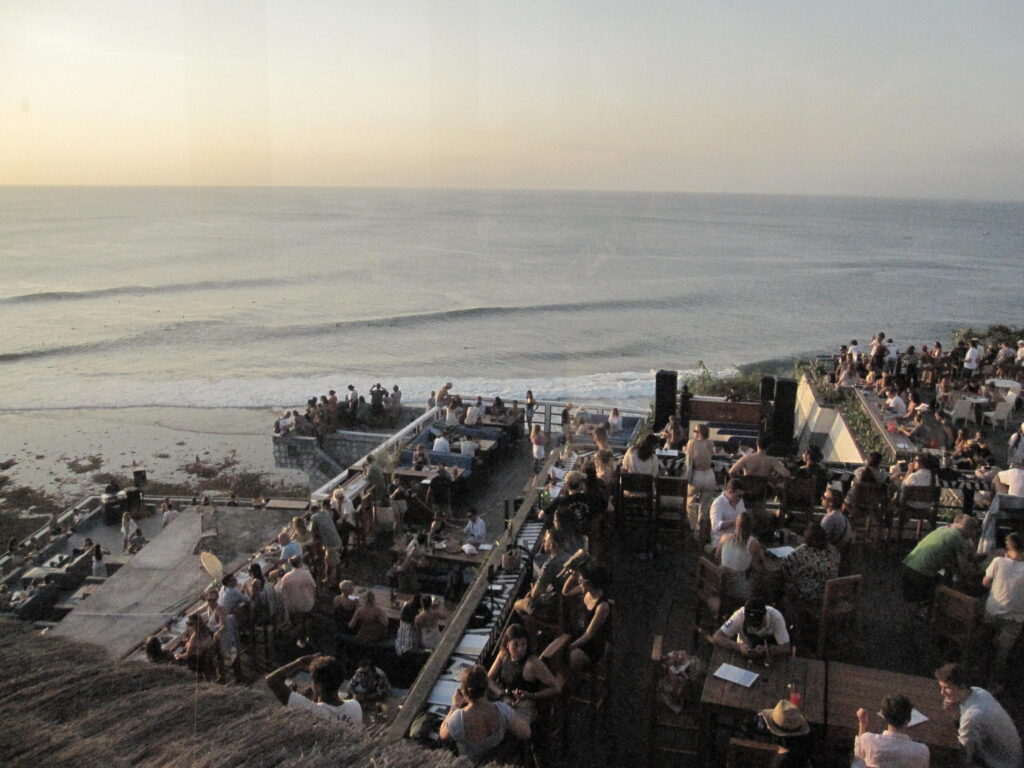
- However, if you simply can’t get enough of the surf action, you can head to Single Fin. Perched high above the cliffs, it’s the ultimate spot to grab a drink and watch advanced surfers navigate the world-famous Uluwatu Point Break. Seeing the pros take on those long, heavy lines from a bird’s-eye view is the perfect way to study the ocean and get inspired for your next lesson.